


Collagen for hair growth: What it does, what it doesn’t, and whether supplements actually help
What exactly can collagen do to reduce your tress stress?



Key takeaways
- Collagen is essential for hair health — it protects the stem cells that regenerate follicles, strengthens hair shafts, and provides amino acids needed for keratin production.
- Most collagen supplements have limited evidence for speeding up hair regrowth, but hydrolysed collagen (particularly marine collagen) shows the most promise, with one study finding a 27–32% improvement in hair density after 12 weeks.
- Collagen levels naturally decline from your mid-20s and drop significantly during menopause, but lifestyle factors like UV exposure, smoking, and poor sleep can accelerate this loss.
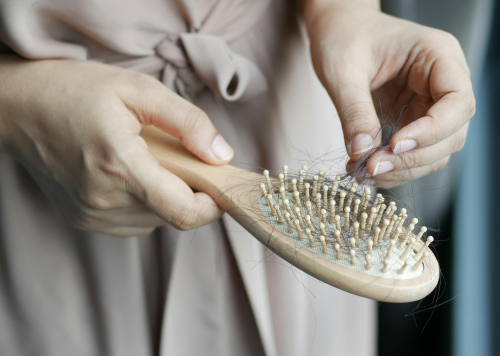
For many of us, hair is more than just hair. It's an accessory, a source of self-expression and sometimes even a security blanket. Whether it's a haircut gone wrong or you're starting to experience Female Pattern Hair Loss (FPHL), flat or thinning hair can really knock your confidence.
Unfortunately, there's no way to achieve long, flowing Rapunzel locks overnight, but there are things you can do to support healthy hair growth. Enter, collagen — everyone's favourite all-rounder protein, which might just be your shortcut to a good hair day, every day. But, what exactly can collagen do to reduce your tress stress, and are supplements actually a helpful way to reap the benefits?
Read on for everything you need to know about collagen for hair growth.
What is collagen?
Collagen is the most abundant protein, comprising about 30% of the body's total protein [1]. You can think of it as internal scaffolding inside your body, providing structure to your bones, muscles, tendons and skin. With a fibre-like structure, it plays an essential role in maintaining the strength and elasticity of your connective tissue. Collagen also helps with cell renewal by accelerating the replacement of damaged cells. In other words, collagen proteins are the building blocks that hold the human body together — and your hair is no exception.
Why is collagen important for hair?
Chances are, when you think of collagen, you envision plumping skincare products and injectables. And while yes, collagen is essential for skin elasticity, it's also just as important for your mane game.
At any given time, our bodies are somewhere in the natural four-stage hair shedding cycle: Anagen (growth, 2–7 years), Catagen (transition, 2–3 weeks), Telogen (resting, 3–4 months), and Exogen (shedding 50–100 hairs daily) [2]. Follicles (tiny-tube shaped organs that produce hair) naturally regenerate over time using stem cells, so that this hair can grow back. However, this can only happen if those stem cells are protected by collagen type 17A1 — a type of transdermal protein that plays a crucial role in skin and hair health [3]. Hence, collagen proves crucial for maintaining healthy hair.
The relationship between collagen and scalp health
Many of us forget that our scalp is actually part of the skin — and underestimate the role it plays in overall hair health. Your scalp is where your hair follicles grow. The more of these hair follicles you have, the greater your hair density — impacting how thick your locks will appear. A healthy and well-hydrated scalp also creates an optimal environment to strengthen the hair follicles. This, in turn, leads to healthier hair strands and an overall more luscious appearance.
The role of collagen in hair structure
Collagen also supports hair structure by strengthening the hair shafts, reinforcing follicles within the scalp, and providing essential amino acids for keratin production [4]. As a key component of the dermis, it acts as 'glue' for follicles, reduces breakage, and helps prevent age-related thinning.
What happens when collagen levels decline?
Like many bodily processes, collagen production gradually slows with age. Generally, this looks like a 1 to 2% decrease every year from your mid-20s onwards [5]. However, many women find that their collagen levels start to decline more significantly during menopause, losing around 30% in the first five years [6]. As well as functional skin changes such as sagging, drying and deepening of wrinkles, you may also notice other signs of collagen loss, such as brittle nails or hair loss. What a joy!
Just like your skin, environmental factors can speed up hair ageing. UV exposure is one of the biggest causes of early collagen loss on the scalp — a good reminder to wear a hat, even on those grey, dreary days! Other factors include smoking, air pollution, excessive alcohol consumption and poor sleep [7].
Will taking collagen supplements improve hair growth?
From liquid collagen to collagen powders, you may have noticed a growing range of hair supplements that claim to support hair growth. So, does collagen supplementation actually work? The answer is, "yes and no." There are limited studies that show that collagen can speed up hair regrowth in any significant way. The exception to this is hydrolysed collagen, with a recent small-scale study showing a measurable improvement in both hair density and perceived appearance after 12-weeks of consistent use (a 27.6 and 31.9% increase, respectively) [8].
There is also evidence that collagen supplements can certainly help with overall hair health by providing the amino acids needed to build keratin [9]. This can potentially improve the strength of your strands and reduce further breakage. The added benefit is that it will likely help your skin and nail health, too.
It's important to note that a collagen deficiency isn't the only factor that plays a role in hair loss or thinning. Stress, hormones, rapid weight loss and illness can also disrupt the hair growth cycle. These factors can force hair follicles into a premature resting phase called 'telogen effluvium', causing them to shed faster than normal [10]. If you are experiencing these issues, taking a collagen supplement may help, but it is unlikely to truly address the root cause (pun intended).
To achieve healthy hair growth, a holistic approach is typically more effective. With a range of oral and topical options, Juniper's new Hair Renewal Treatment program provides personalised, science-backed support for hair thinning and loss. By targeting collagen production and scalp health from the inside out — while also actively reducing shedding — you can expect to see healthier, fuller-looking hair in three to six months.
What type of collagen is best for hair growth?
When it comes to hair growth and strength, not all collagen supplements are created equal. Generally speaking, you'll want to go for a hydrolysed collagen (also known as collagen peptides), as this is a broken-down form of protein that's bioavailable (ie, your body can actually use it) [11].
One of the best hydrolysed types is marine collagen. As well as having high absorption levels, it contains types I and III collagen, which are crucial for structural support [12]. Another effective type of hydrolysed collagen supplement is bovine collagen, which, as the name suggests, is derived from cows (as well as yaks, antelopes and buffalo). The substance, taken from bovine hides and bones, is high in bioavailable collagen that helps foster healthy hair growth.
Ways to add more collagen to your diet
As well as oral supplementation, you can also boost your collagen levels through your food. Oily fish such as salmon is one of the best dietary sources of collagen — just make sure to get it with the skin on, as that's where all the Omega-3-boosting goodness is! [13] Other collagen-rich foods include animal sources such as tough meats with lots of connective tissue (think, brisket and chuck), chicken, fish and bone broth. Oysters are another surprising hair (and skin) superfood, with their collagen-boosting benefits attributed to their high zinc content.
Can topical collagen treatments work?
You may come across products marketed as 'collagen hair masks' or similar in your local supermarket or Boots. While they sound promising, these usually aren't too different to other types of hair masks that nourish your hair (but don't necessarily help to regrow it).
If you're looking for a topical treatment to repair your hair, you may want to consider a more medically-backed approach. Available through Juniper's Hair Renewal Treatment program, Boost is a gentle, non-irritating topical serum that's applied directly to your scalp to promote stronger follicles. Another option is Regaine — a topical Minoxidil treatment that has been found to reliably promote hair growth.
Boosting collagen for hair growth: Where to start
When it comes to supplements for hair growth, one size doesn't fit all. Everyone's hair is different, and so are the factors driving hair loss.
If you're experiencing the early stage of temporary hair loss (perhaps due to pregnancy or breastfeeding), a topical serum, chewable oral medication, or topical foam like Regaine may be the way to go. If your hair thinning is more severe or chronic, you may need to explore a hormonally-driven hair loss solution.
The good news is, you don't have to guess your way to healthier-looking hair. With Juniper's Hair Renewal Treatment program, you'll get a free consult with a clinician who can recommend the best support for your unique needs. You'll also get access to our curated range of hair care products and unlimited follow-up consultations — to ensure you're covered at every stage of your hair regrowth journey.
Ready to see what's right for your hair? You can get started with our no-strings-attached questionnaire.
Image credit: Pexels
in 1 year
- No GP referral
- Ongoing expert support
- Trusted by 260,000 members worldwide

“I was always on this yo-yo diet scenario, which never worked. I always just felt hungry throughout the dieting process and it actually kinda gets you down”


“Juniper has been my weight loss miracle, we all need help on our weight loss journey, especially because it gets harder the longer it goes on.”

“Juniper's just given me my confidence back. That's what my friends are saying, “You've got your smile back, you've got your sparkle back,” which I know I'd lost.”
- https://link.springer.com/protocol/10.1007/978-1-4939-9095-5_13
- https://onlinelibrary.wiley.com/doi/abs/10.1111/j.1346-8138.1998.tb02507.x
- https://www.mdpi.com/2079-9284/12/4/156
- https://onlinelibrary.wiley.com/doi/abs/10.1111/1346-8138.13897
- https://www.sciencedirect.com/science/article/abs/pii/S0002934325002839
- https://link.springer.com/article/10.2165/00128071-200304060-0000
- scholar.google.com/scholar_labs/search/session/14476723262322900776?hl=en
- https://pubmed.ncbi.nlm.nih.gov/39021368/
- https://www.dryagoda.com/wp-content/uploads/2023/04/NutritionandFoodSciencesJournalArticle.pdf
- https://academic.oup.com/ced/article-abstract/27/5/389/6626131
- https://www.sciencedirect.com/science/article/pii/S1756464624001269
- https://pmc.ncbi.nlm.nih.gov/articles/PMC11050892/


